
Vacuum glazing and planning: what 383 applications tell us
Ask whether a council will let you fit vacuum glazing in a period home and you will usually get an opinion. We wanted evidence. So we gathered every planning and listed building application in England whose description names vacuum glazing — 383 of them, from the first in Bath in 2017 to the start of October 2026 — and read the decision notices, officer reports and appeal decisions behind the refusals. The short answer is encouraging: about 85% of decided applications were approved, and the rate is rising. The longer answer is more useful, because the refusals are not random. They cluster around a handful of avoidable mistakes — above all, how the glazing bars are handled.
The numbers at a glance
| Measure | England, 2017 – 8 October 2026 |
|---|---|
| Applications naming vacuum glazing | 383 |
| Separate projects (planning + listed building pairs merged) | about 286 |
| Councils with at least one application | 89 |
| Decided applications | 309 |
| Approved (including approval with conditions) | 264 — 85% |
| Refused (including one split decision) | 45 — 15% |
| Withdrawn before a decision | 28 |
| Still undecided on 8 October 2026 | 46 |
| Median time from receipt to decision | 68 days |
Two things put the 85% in context. First, listed buildings are where the friction is. Almost three in five applications were for listed building consent, and councils approved 84% of those they decided; projects that needed only planning permission were approved 94% of the time. Across all kinds of work, councils in England grant about 92% of listed building consent applications (government statistics, year to June 2026), so a vacuum-glazing application to a listed building is roughly twice as likely to be refused as the average one — though windows are among the most contested categories of listed-building work anyway.
Second, withdrawals hide refusals. Official statistics ignore them, but in heritage casework a withdrawal is often what a refusal looks like from outside: the officer signals a no, and the applicant pulls the application. Counting both, roughly one closed case in five did not end in consent.
Most vacuum glazing applications succeed. One in five does not — and the commonest reason is not the glass but the joinery around it: glazing bars cut away and replaced with stuck-on strips. Done with proper joinery, even one pane per sash can win consent.
Applications have multiplied since 2021
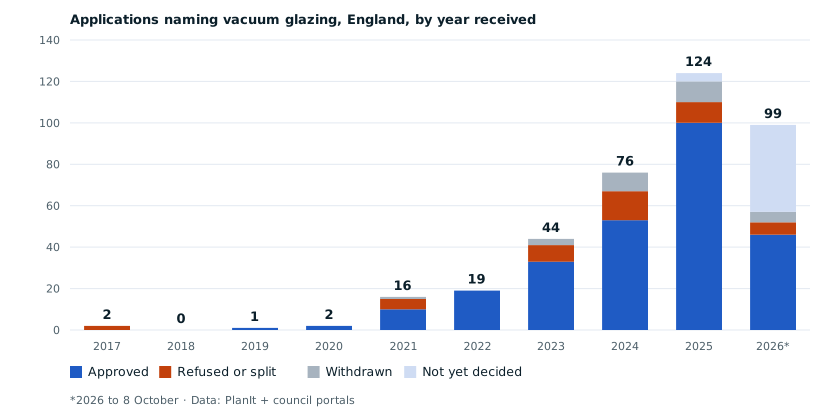
The first applications we can find are a pair in Bath in 2017, for Pilkington Spacia in a converted Grade II hospital; both were refused and the appeal dismissed. Then the curve bends sharply: 16 applications in 2021, 44 in 2023, 76 in 2024 and 124 in 2025, with 99 already by early October 2026.
The approval rate has risen with the volume: 80% of decided applications made before 2025 were approved, against 90% of those made since. That shift coincides with Historic England’s Advice Note 18, Adapting Historic Buildings for Energy and Carbon Efficiency (July 2024, revised February 2026), whose paragraph 81 says “slim-profile or vacuum double-glazing within historic frames will generally be acceptable”. We cannot prove cause, but officers and inspectors now quote it routinely. The products have changed too: the early refusals involved first-generation units with a visible evacuation point, which current units do without (see the six components of a vacuum unit).
Where the applications are
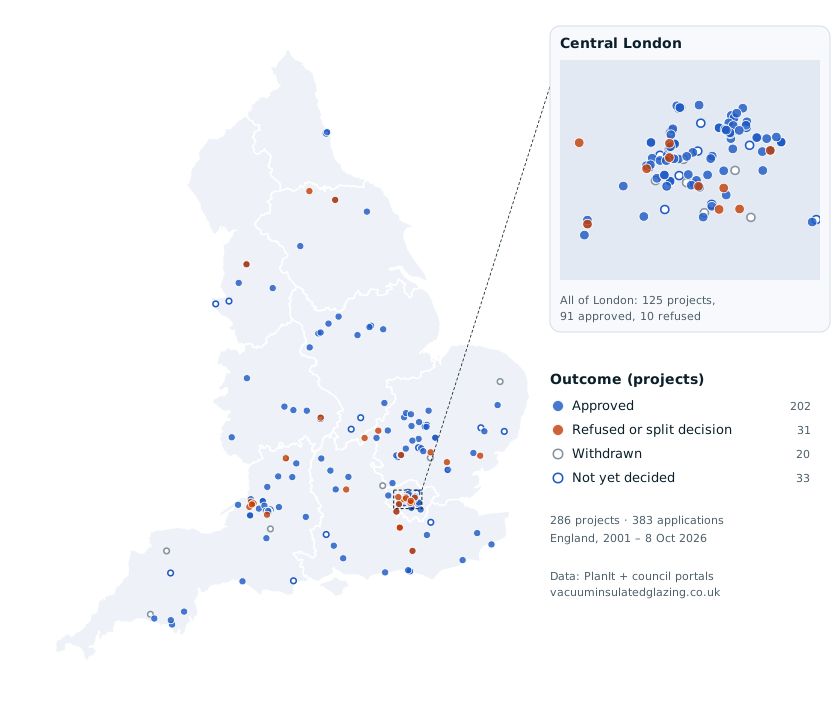
Almost half of all applications (187) are in London, nearly a third of those in Westminster alone. Outside the capital the stand-out is Bath and North East Somerset, with 35, which with Bristol makes the South West the second-busiest region. The Midlands and the whole of the North together account for just 42.
| Council | Applications | Approved | Refused | Withdrawn | Undecided |
|---|---|---|---|---|---|
| Westminster | 56 | 42 | 5 | 4 | 5 |
| Bath and North East Somerset | 35 | 27 | 2 | 0 | 6 |
| Islington | 24 | 22 | 0 | 1 | 1 |
| Kensington and Chelsea | 24 | 17 | 2 | 5 | 0 |
| Tower Hamlets | 22 | 19 | 2 | 0 | 1 |
| Lambeth | 15 | 8 | 3 | 2 | 2 |
| Camden | 11 | 6 | 0 | 1 | 4 |
| North Hertfordshire | 11 | 7 | 1 | 1 | 2 |
| Bristol | 10 | 6 | 4 | 0 | 0 |
| South Cambridgeshire | 7 | 7 | 0 | 0 | 0 |
| Southwark | 5 | 1 | 2 | 2 | 0 |
Refused includes split decisions. Counts are applications; many projects file a planning and a listed building application together.
This is a map of where people have asked, not of where vacuum glazing is allowed: it follows period housing, listed terraces and active conservation teams. A council with no applications has simply not been asked yet.
Where it gets approved
The clearest pattern is experience. The five councils that have handled ten or more vacuum-glazing projects — Westminster, Bath and North East Somerset, Islington, Kensington and Chelsea and Tower Hamlets — approved 93% of the projects they decided, against 81–83% elsewhere. It fits what officers write: once a team has seen a sample and a few finished jobs, the question moves from whether to how. Islington has the cleanest record of any busy council — 22 approvals from 24 applications naming vacuum glazing, none refused.
Approvals reach further up the heritage scale than many assume. In December 2023 the City of London approved vacuum glazing across Crescent House on the Golden Lane Estate, a Grade II* modernist block, after a one-flat pilot reviewed by Historic England, the Twentieth Century Society and residents and tested for acoustics and airtightness. A trial installation is the strongest evidence an applicant can offer.
We read the officer reports behind a sample of thirteen approvals. Five things recur:
- The windows being changed mattered little — modern, replacement or beyond repair in twelve of the thirteen. None involved surviving historic glass.
- The historic framework stayed: existing sashes were re-glazed, or new sashes went into retained box frames, copying the original pattern and profiles.
- Officers accepted that it reads as single glazing. One found the pillars “hardly noticeable”; none objected to pillars or reflections.
- It is not only back windows: front elevations were approved in Westminster, Tower Hamlets and South Cambridgeshire, and two approvals were Grade II* buildings.
- The paperwork was there: large-scale joinery drawings, a window schedule or condition survey, and sometimes a sample or pre-application talks.
The conditions are almost all about joinery, not glass: bar profiles drawn at 1:1 and 1:5, work built exactly to the approved drawings. Comparisons within one council make the point. Tower Hamlets refused new sashes in one Georgian terrace because the windows were in good condition, and approved them in another a year later because they were rotten; Lambeth approved vacuum glass in original sashes with the bar profile kept, and refused it where one sheet sat behind applied bars. The glass was the same; what changed was what it replaced and how it was detailed.
Where it gets refused — and why
Refusals are thinly spread: 24 councils have refused at least one application, most of them only once. Southwark is the hardest place in our data — one approval from five applications — partly by policy: its 2025 guidance says double glazing “will not typically be permitted in Listed Buildings, including slim versions”, despite Historic England’s objection. Even there, it consented vacuum-glazed sashes for windows in disrepair in February 2026.
We read the decision notices, officer reports and appeal decisions for every refused and withdrawn case we could reach — around 35 schemes with published reasoning. In roughly two in three, the objection was at least partly about how the vacuum glazing was to be fitted; in the rest, it was other works or missing evidence. Six reasons recur.
1. Glazing bars stuck on rather than built in
This is the most common reason of all — a factor in about half of the refusals with published reasoning — but it is a question of how the bars are done, not a ban.
A multi-pane sash can be glazed in two ways: a small vacuum unit in each opening between the bars, or one vacuum unit per sash behind them. The second performs a little better and avoids a practical problem — every unit has an edge seal (and often a getter) running several millimetres in from its edge, which can show beside a slender bar — but the outer part of each bar can then no longer be the original timber. Advice Note 18 says “stuck-on or applied glazing bars … are unlikely to be acceptable”, and the refusals show what officers mean: thin strips glued or taped to one large sheet, timber beads instead of putty, original bars sawn in half. Bristol, Lambeth, Southwark, Westminster, Tower Hamlets, Cheltenham and Uttlesford all refused schemes like these. A Bristol inspector accepted in 2025 that the glass itself would look like single glazing, but called the applied bars “disingenuous”.
Done properly, it gets approved — even in original sashes
In September 2026 Westminster granted consent to re-glaze the original sashes of a Grade II Maida Vale house with one vacuum pane per sash. The inner part of every original glazing bar was kept; only the outer face was trimmed back, and the profile rebuilt in jointed-in timber bars, puttied and painted to match. Because the existing glass was modern plate rather than historic, the officer judged the harm “very minor” and found it “considerably” outweighed by the gain in thermal and acoustic performance. The application’s own photographs show how little of the window changes:
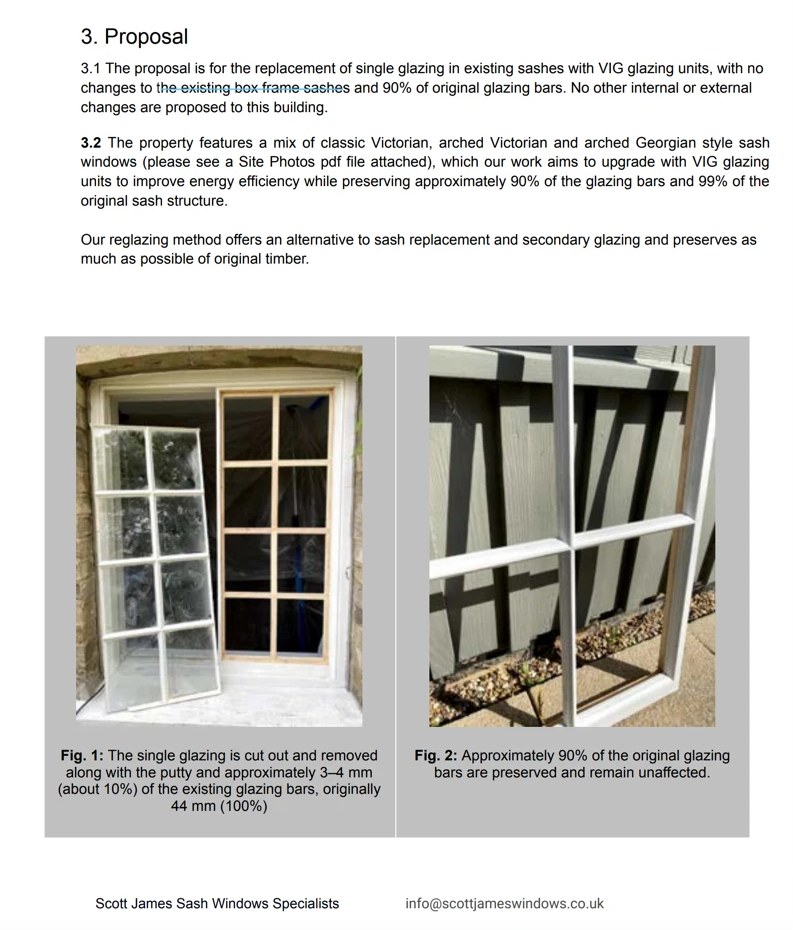
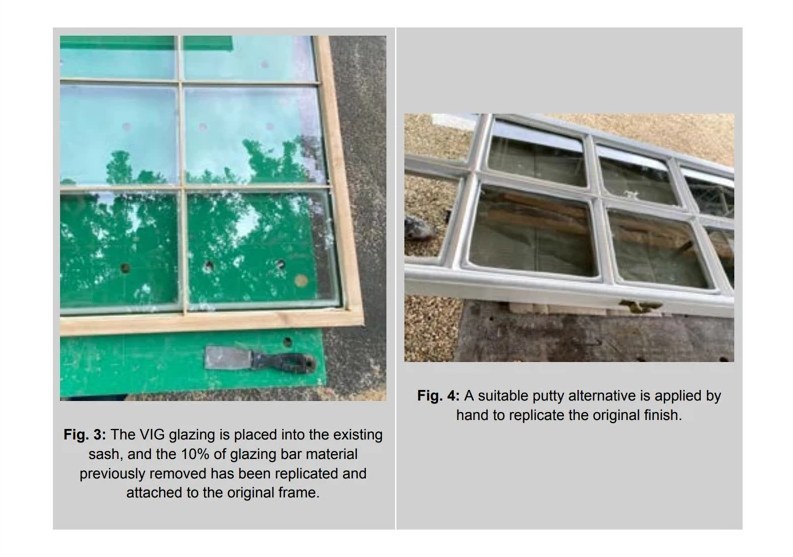
Two appeals have gone the same way where the joinery was convincing — North York Moors (2025) and Charnwood (2026). The pane-by-pane route remains the safest of all: Tower Hamlets approved vacuum glass fitted pane by pane behind original bars a year before refusing surface-mounted bars in the same street. The line is craftsmanship and what is lost: keep as much original bar as possible, rebuild what must change in jointed, puttied timber, and show it at full size in the drawings.
2. Historic glass would be lost
Advice Note 18’s first exception is “windows which retain historic glass of interest”, and officers in Cheltenham, Bristol, Milton Keynes and North Somerset applied it. But old is not automatically historic: in Elmbridge, an inspector allowed a 2025 appeal after finding that scratched, mass-produced 1920s glass was not of special interest. In Tendring, by contrast, an inspector dismissed an appeal in January 2026 because nobody had established which panes were early glass — and refused to leave that to a condition.
3. The pillars show
The grid of tiny support pillars is visible up close, and some officers who saw samples objected: a Grade II* hall house in Mid Sussex (2023, “spotty” against pale backgrounds), the principal elevation of a Grade II villa in Leamington Spa (2025, pillars that “read as dots” — the same council approved vacuum glass at the back), and Southwark (2026). An Islington appeal in 2022 was dismissed partly on the same point. Others disagree — the Bristol inspector found the change in reflections “imperceptible”. Appearance matters most on the front elevation of higher-grade buildings, least on rear and secondary windows.
4. The whole window was being replaced
Councils are far more relaxed about new glass in an old frame than about a new frame. Advice Note 18 says original windows should keep their frames, with panes “replaced with slim-profile or vacuum double-glazing within the existing frames”. Schemes replacing sound windows without a condition survey were refused in Tower Hamlets, Bristol, Uttlesford and Westminster. In the North York Moors, a 2021 plan for new windows drew a strong objection; switched to vacuum glass in the existing frames, it was approved in 2022.
5. Missing information
Richmond refused a 2021 scheme because the drawings gave no glass depths and no survey of the glazing bars; resubmitted with sections, it was approved three months later. Officers repeatedly ask for the same things: a window-by-window schedule of what is original, 1:5 and 1:20 sections, the product’s specification and unit depth, a sample, and an explanation of why secondary glazing is not enough.
6. Something else in the scheme
Some “vacuum glazing refusals” are nothing of the kind. Mole Valley’s officers called the vacuum glazing acceptable but refused a lift and internal changes; the scheme was allowed on appeal in 2025. Preston refused a 2024 scheme with a large rear extension, then approved the vacuum glazing in 2025 once the extension was dropped. Others fell on internal openings, tilt-and-turn frames or solar panels.
One more thread runs through the reports: until recently, energy saving was usually treated as a private benefit to the occupant, carrying little weight against even minor harm. National policy has just changed that.
The appeal record
We found twelve appeal decisions in England in which vacuum glazing was central to the case.
| Decided | Council | Outcome | What decided it |
|---|---|---|---|
| May 2018 | Bath and North East Somerset | Dismissed | Visible sealing points and pillars on early units in small panes |
| Apr 2022 | Islington | Dismissed | Pillar grid and thickness judged “alien” on a Georgian terrace; thin specification |
| Jul 2024 | Cherwell | Split | Allowed in modern windows; refused where historic frames and glass would be lost |
| Jan 2025 | North York Moors National Park | Allowed | Sample seen on site; sashes were 1990s copies; bars convincingly detailed |
| Apr 2025 | Mole Valley | Allowed | Vacuum glazing never the problem; energy benefit outweighed other harm |
| May 2025 | Southwark | Dismissed | Bid to swap consented through-bar glazing for one sheet with applied bars |
| Oct 2025 | Bristol | Split | Allowed in non-original windows; originals to be repaired |
| Nov 2025 | Bristol | Dismissed | Glass acceptable, applied bars over a single sheet “disingenuous” |
| Nov 2025 | Elmbridge | Allowed | Retrofit into existing sashes; 1920s glass not of special interest |
| Jan 2026 | Tendring | Dismissed | No evidence on which glass was historic or whether the bars could take the units |
| Jul 2026 | Liverpool | Dismissed | Inconsistent drawings and unit depths; existing glass not assessed |
| Aug 2026 | Charnwood | Allowed | Decayed windows; slim bonded bars convincing on small, set-back windows |
None of the three appeals before 2025 succeeded outright; of the nine since, four were allowed, one split and four dismissed. The split decisions are the most instructive: in Cherwell and Bristol the same product was proposed for every window, and each inspector allowed it in modern windows and refused it where historic windows or glass would go. The product never decided those cases — the significance of what would be removed did.
National policy now leans harder in favour of good schemes. The National Planning Policy Framework of August 2026 gives “substantial weight” to improving the energy efficiency of existing buildings (policy CC2) and names enabling energy-efficiency measures as an “important public benefit” to weigh against heritage harm (policy HE6) — while also strengthening the weight given to conservation. The Westminster officer applied exactly this, giving “substantial weight” to the energy benefit under CC2.
What the law and guidance say
Works that affect the character of a listed building need listed building consent, and doing them without it is a criminal offence; Advice Note 18 says consent is likely to be needed “unless replacing panes in modern windows”. Planning permission is separate: a house in a conservation area can usually replace windows of similar appearance without it unless an Article 4 direction removes that right, while flats need permission for visible changes. Historic England issues guidance, not approvals — no product is “Historic England approved” — and its guidance, in short, accepts vacuum glazing within historic frames except where there is historic glass of interest, frames too weak to carry it, or leaded lights; asks for original bars to be kept; and treats secondary glazing as the low-risk alternative. Our guide to vacuum glazing for listed buildings covers this in depth.
Local guidance is catching up. At least fifteen councils and national park authorities now name vacuum glazing in their own documents — among them Islington, Hackney, York, Oxford, Bath and North East Somerset, Warwick, Lancaster, Cornwall and the South Downs. None treats it as a special case, and their thickness caps for heritage units (12 mm in Bath and Cornwall, 14 mm in Westminster, 16 mm in Islington) sit comfortably above a 6–8 mm vacuum unit. The awkward exception is Kensington and Chelsea’s 2026 consent order, whose 12–16 mm range leaves the slimmest units out (see the Kensington and Chelsea exception). There is still no national consent order for glazing, though the government says it will consider the issue as part of wider planning reform.
How to give an application the best chance
- Find out what is original before you apply. A window-by-window schedule of which frames and glass are historic answers the first question every conservation officer asks. Where crown or cylinder glass survives, expect to keep it and use secondary glazing on that window.
- Re-glaze rather than replace. Vacuum units in existing, repaired sashes is the route the guidance supports most clearly and councils approve most readily.
- Get the glazing bars right. This is the biggest single cause of refusal. Pane by pane is safest. If you use one unit per sash, keep the inner part of the original bars, rebuild only the outer face in jointed-in, puttied timber, and show it in 1:1 sections — never strips glued or taped to the glass. Check the unit’s edge-seal width and edge clearance against your bar widths early (see vacuum glazing for sash windows).
- Show, don’t tell. Submit 1:5 sections, the product data sheet and, if you can, a sample window. Inspectors who allowed appeals since 2025 pointed again and again to exactly that evidence.
- Explain why secondary glazing is not enough — or offer it for the most sensitive windows.
- Quantify the benefit. Policy now gives energy efficiency substantial weight, but the guidance expects a “meaningful improvement”, not an assertion.
- Use pre-application advice, and keep the glazing separate from anything contentious, such as an extension.
- If refused, read the reasons — then consider appealing. Every vacuum-glazing appeal dismissed since 2025 turned on something fixable: applied bars, or missing evidence about the glass and the joinery.
Frequently asked questions
Do I need planning permission to fit vacuum glazing?
Usually not for an unlisted house, as long as the windows look much the same — that is normally permitted development, even in a conservation area. You will need permission where an Article 4 direction removes that right, and in most flats where the change is visible.
Do I need listed building consent for vacuum glazing in a listed building?
Almost always, yes — Historic England’s guidance says consent is likely to be required unless you are only replacing panes in modern windows. Fitting it without consent is a criminal offence. In our data, councils approved 84% of the listed building applications they decided.
Can you have vacuum glazing in a conservation area?
Yes, and it is usually easier than in a listed building: projects in our data that needed only planning permission were approved 94% of the time. The main hurdle is an Article 4 direction, which brings window changes back under planning control.
Does Historic England approve vacuum glazing?
Historic England does not approve products. Its guidance says slim-profile or vacuum double glazing within historic frames “will generally be acceptable”, with exceptions for historic glass of interest, weak frames and leaded lights. Each case is decided by the council.
How long does a decision take?
The median in our data was 68 days — just under ten weeks, a little beyond the eight-week target. Allow longer if officers ask for samples or revised drawings.
What if my application is refused?
Read the reasons: many refusals in our sample were for missing information or other parts of the scheme, and were approved on resubmission. You can appeal to the Planning Inspectorate — within six months for listed building consent. Since 2025, five of nine vacuum-glazing appeals have succeeded in full or in part.
How we did this
We searched PlanIt, which indexes planning registers across Great Britain, for every application whose description mentions vacuum glazing, including brand names (Fineo, LandVac, Spacia) and misspellings such as “vaccum”. From roughly 1,200 matches we removed everything that was not glazing — car-wash vacuums, hospital oxygen tanks, solar tubes, lifts — kept England only, and re-checked out-of-date “pending” records against council websites. For refused and withdrawn cases, and a sample of approvals, we read the published decision notices, officer reports and appeal decisions.
The search only finds applications that name vacuum glazing; schemes that call it “slim double glazing” are missed, so the true number is higher. “Approved” includes approval with conditions, and 2026 is a part year. Nothing here is planning or legal advice.
The bottom line
Vacuum glazing is now a mainstream heritage planning request, and councils approve the large majority of applications — increasingly so since Historic England’s 2024 advice named it. Refusals are real but predictable. The commonest is the joinery, not the glass: original bars cut away and replaced with stuck-on strips — while the same idea done in jointed, puttied timber has been approved even in original sashes. After that come lost historic glass, visible pillars on important front elevations, windows replaced that could have been re-glazed, and thin evidence. Avoid those, show the council exactly what the finished window will look like, and the odds are firmly on your side.
Get the next issue
Vacuum glazing is moving fast — new products, prices and standards. Get the highlights and our independent take once a month, free.
- New products & price moves, the month they land
- Straight comparisons — Fineo, LandVac, Spacia & the newcomers
- Plain-English analysis from an independent team
You're on the list.
Check your inbox to confirm — then look out for the next issue. Thanks for reading.