
The six components of a vacuum glazing unit — and what each one does
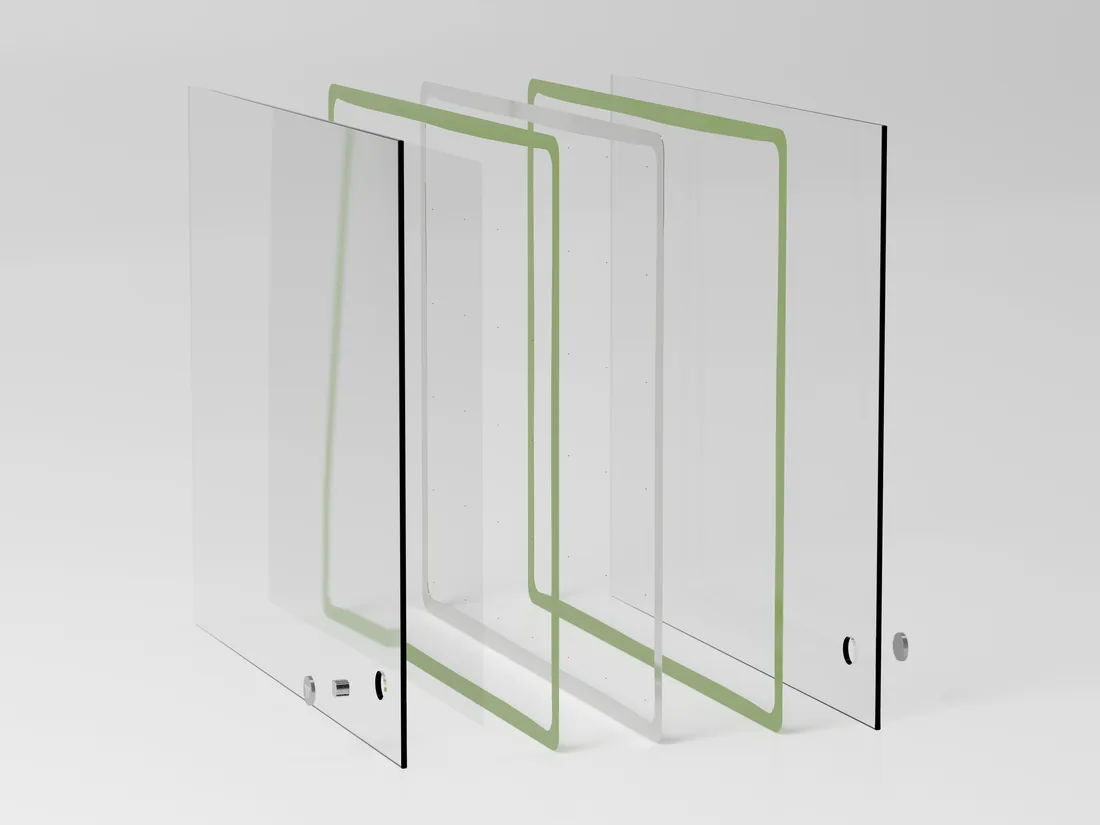
Hold a vacuum insulated glazing unit in your hands and it looks like almost nothing: a single slab of glass, 6–8 mm thick, no thicker than the pane in a Victorian sash. That plainness is deceptive. Inside is one of the most carefully balanced assemblies in modern building products — two sheets of glass, an invisible metallic coating, a gap thinner than a human hair holding a near-perfect vacuum, an array of pillars each carrying the load of a small car, a hermetic seal expected to stay airtight for decades, and a chemical sponge quietly cleaning up stray gas molecules for the life of the unit. This guide takes the unit apart, component by component, and explains what each part is, what it is made of, and why it has to be exactly the way it is.
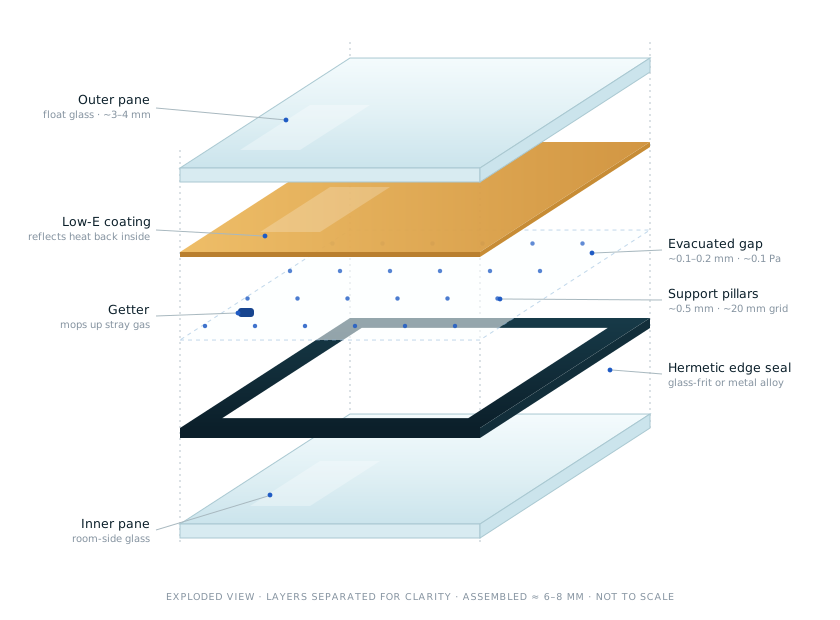
The anatomy at a glance
Before the detail, it helps to see how the parts sit together in cross-section. Everything in a vacuum unit exists to do one of two jobs: hold the vacuum (the seal, the getter, the glass itself) or manage the heat that still tries to cross (the coating, the pillars, the gap). A part that fails at either job compromises the whole unit — which is why each one is engineered with so little margin for error.

Here is the full parts list, with the numbers that matter:
| Component | Typical size | Material | Job |
|---|---|---|---|
| Glass panes (×2) | ~3–4 mm each | Float glass (annealed or tempered) | Structure; carries the atmospheric load |
| Low-E coating | Sub-micron film | Silver or metal-oxide stack | Blocks radiant heat across the gap |
| Evacuated gap | ~0.1–0.2 mm at ~0.1 Pa | — (near-vacuum) | Eliminates conduction and convection |
| Support pillars | ~0.5 mm across, on a ~20 mm grid | Stainless steel or ceramic | Hold the panes apart against ~10 t/m² |
| Edge seal | A few mm around the perimeter | Glass frit or metal alloy | Keeps the cavity airtight for decades |
| Getter | Small strip or pill in the cavity | Reactive metal alloy | Absorbs residual gas over the years |
Now, each part in turn — starting with the two components everyone can see.
1. The glass panes
The two sheets of glass are the only components you will ever consciously look at, and in one sense they are the most ordinary part of the unit: standard soda-lime float glass, the same basic material as any window. Each pane is typically 3–4 mm thick, which is why a finished unit comes out at roughly 6–8 mm overall — against 24–28 mm for a modern sealed double-glazed unit.
The interesting choices are in the specification:
- Annealed or tempered. The original generation of vacuum glazing uses annealed (ordinary) glass, because its rigid edge seal is fired at temperatures high enough to un-temper any toughened pane (more on that below). Newer designs seal at much lower temperatures, which lets the panes stay fully tempered safety glass — a meaningful difference for doors, low-level glazing and anywhere Building Regulations demand impact safety.
- Low-iron glass can be specified for higher clarity. Ordinary float glass has a faint green cast from its iron content; with so little material between inside and outside — no thick gas cavity, no third pane — a vacuum unit built on low-iron glass is optically closer to old single glazing than almost any other modern glazing.
- Laminated variants. Where safety or acoustics demand it, a vacuum unit can be laminated to an additional pane with a plastic interlayer, trading a little slimness for impact resistance and extra sound damping.
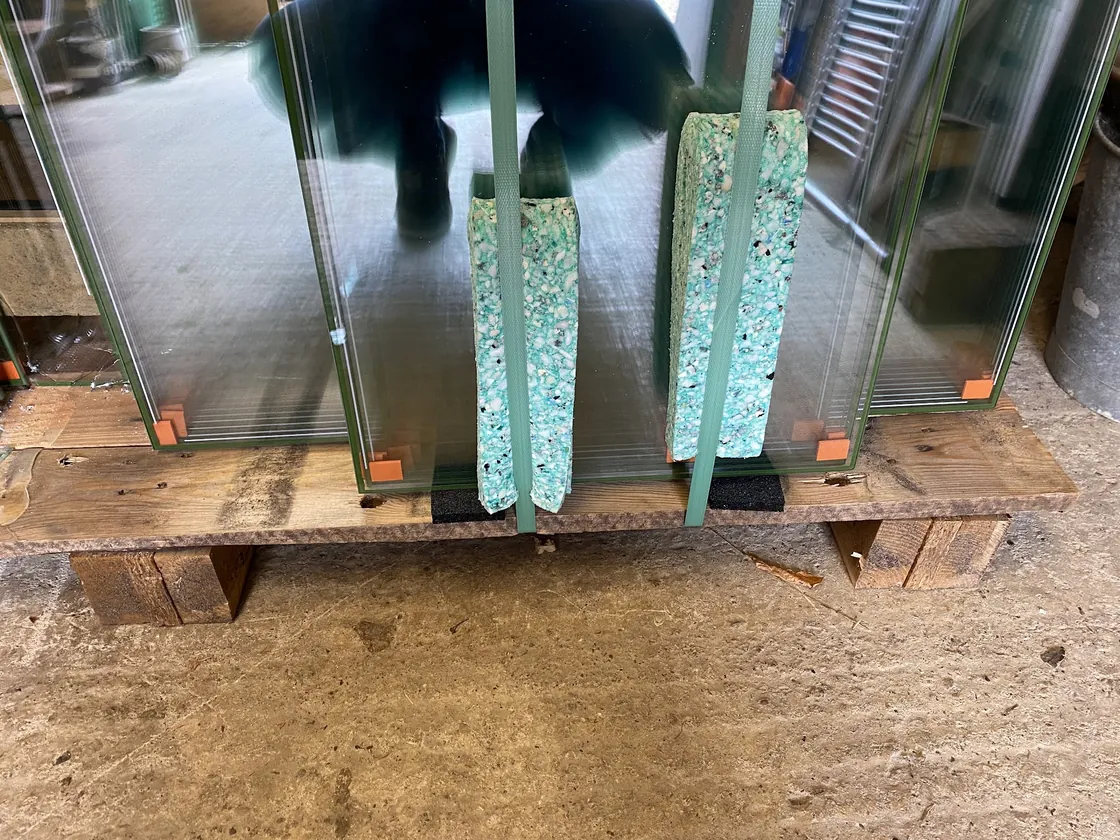
The panes also do a structural job that double glazing never asks of its glass. Because the cavity holds a vacuum, atmospheric pressure squeezes the two sheets together permanently, at roughly 10 tonnes per square metre. The glass has to carry that load, bending slightly between pillars, every hour of its service life, through summer heat and winter frost. It is a quiet reminder that in a vacuum unit even the “ordinary” parts are working hard.
2. The evacuated gap
The gap is the component that gives the technology its name, and the easiest one to misunderstand. It is not “a gap filled with vacuum” in the way a double-glazed cavity is filled with argon. It is the deliberate near-absence of anything at all: a space about 0.1–0.2 mm wide — the thickness of a sheet of paper — pumped down to a pressure of around 0.1 Pa, roughly a millionth of normal atmospheric pressure.
Why does that work? Heat crosses an ordinary glazing cavity three ways: conduction through the gas, convection as the gas circulates, and radiation between the glass surfaces. In a standard low-E double-glazed unit the gas accounts for the large majority of the heat lost. Remove the gas and both conduction and convection simply stop — there is nothing left to conduct or circulate.
The reason the pressure has to be so low is a piece of physics worth knowing. Gas conducts heat by molecules colliding with one another, passing energy from the warm pane towards the cold one. Thin the gas enough and molecules stop meeting in the middle: each one flies straight from pane to pane without a collision. Below roughly 0.1 Pa, the gas contribution to heat flow becomes negligible — and it keeps falling in proportion as the vacuum improves further. That is the target the manufacturing process has to hit, and the getter’s job (component seven) is to hold it there for decades.
The counter-intuitive part is the width. A wider vacuum would not insulate better — a vacuum has no thickness-dependent performance the way an insulation batt does. Keeping the gap at a tenth of a millimetre keeps the unit slim, keeps the pillar heights manufacturable, and keeps the mechanical stresses manageable. The gap is as thin as it can be while keeping the two panes — and their coatings — reliably apart.
The vacuum is the one component you cannot see, touch or photograph — and it does more of the insulating work than everything else combined.
3. The low-E coating
Stopping the gas deals with conduction and convection, but radiation crosses a vacuum untroubled — sunlight reaching Earth is proof enough. Once the gas is gone, radiation becomes the dominant remaining heat path, and the low-emissivity coating exists to shut it down. Without it, vacuum glazing would perform little better than ordinary double glazing; with it, the physics falls into place.
The coating is a microscopically thin metallic film — far thinner than a wavelength of visible light — applied to one of the two cavity-facing glass surfaces. Its job is to refuse to radiate. Every surface gives off infrared radiation in proportion to a property called emissivity: a perfect radiator scores 1.0, and plain glass is surprisingly good at it, at about 0.84. Coat that surface and the number collapses:
- Uncoated glass: ε ≈ 0.84
- Hard-coat (pyrolytic) low-E: ε ≈ 0.2
- Soft-coat (sputtered) low-E: ε ≈ 0.03
The best soft coats are built around a layer of silver a few nanometres thick, sandwiched in protective metal-oxide layers, and reflect roughly 98% of far-infrared radiation back where it came from. Room heat that would have radiated out through the glass is turned around at the coating and sent back inside.
Vacuum glazing and soft-coat low-E are a particularly happy marriage. Soft coats deliver the lowest emissivity but are delicate — they scratch and corrode if exposed to air and handling. Sealed inside a permanent vacuum, facing a cavity with almost literally nothing in it, a soft coat is better protected than in any other glazing type. Designs typically place one coating on the cavity face of one pane; some use coatings on both cavity faces, which lowers the combined emittance further still.
One practical consequence: the coating is why the outer pane of a well-performing vacuum unit stays cold — and why exterior dew on a crisp morning is a sign of success, not failure. So little heat escapes that the outside face no longer warms up. We cover that effect fully in our guide to condensation and real-world performance.
4. The support pillars
Pump the air out from between two sheets of glass and the atmosphere will try, relentlessly, to push them back together — at that figure worth repeating: about 10 tonnes on every square metre. Something has to hold the gap open. That something is an army of support pillars: tiny discs, each around 0.5 mm across and a tenth to a fifth of a millimetre tall, laid out in a regular grid across the entire cavity, typically ~20 mm apart. A one-square-metre unit contains roughly 2,600 of them.
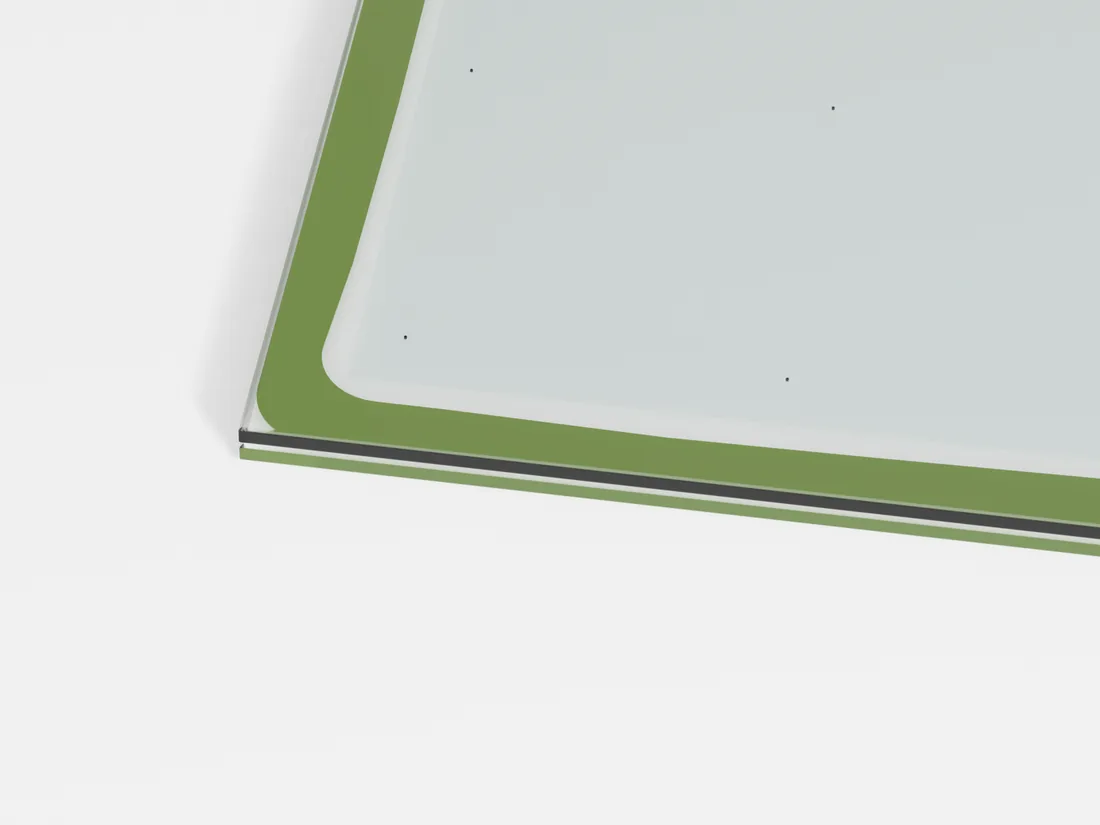
The engineering demands on each pillar are severe. Divide ten tonnes among the pillars on a square metre and each carries several kilograms across a contact patch a fraction of a millimetre wide — compressive stresses at the contact point can exceed 1 GPa, comparable to the pressures deep in machine bearings. The pillar must not crush, must not creep over decades, and must not crack the glass pressing down on it. Two families of materials dominate: high-strength metals (commonly stainless steel), chosen for sheer resilience, and ceramics, which trade a little robustness for lower thermal conductivity. Transparent pillar materials have also been developed to make the array even less visible.
That thermal point matters because the pillars are the technology’s built-in compromise. Each one is a tiny solid bridge across the vacuum — a path heat can conduct through directly, bypassing everything the vacuum achieves. Pillar conductance is one of the main things separating a vacuum unit’s real-world U-value from its theoretical one. Designers respond by making pillars from lower-conductivity materials (a ceramic pillar can cut individual pillar heat flow by 20–30%) and by spacing them as widely as the glass can stand. Tempered glass, being stronger, tolerates a much sparser array — one reason tempered vacuum units post the lowest U-values. The trade-off is unforgiving: space the pillars wider and the glass bends and stresses more between them; pack them tighter and the unit leaks more heat.
Can you see them? Up close, yes — a faint, regular pattern of dots, most visible against dark backgrounds or low sun. At arm’s length they disappear entirely. On cold clear mornings they occasionally reveal themselves another way: exterior dew forms in a delicate pattern around each slightly-warmer pillar point before burning off.
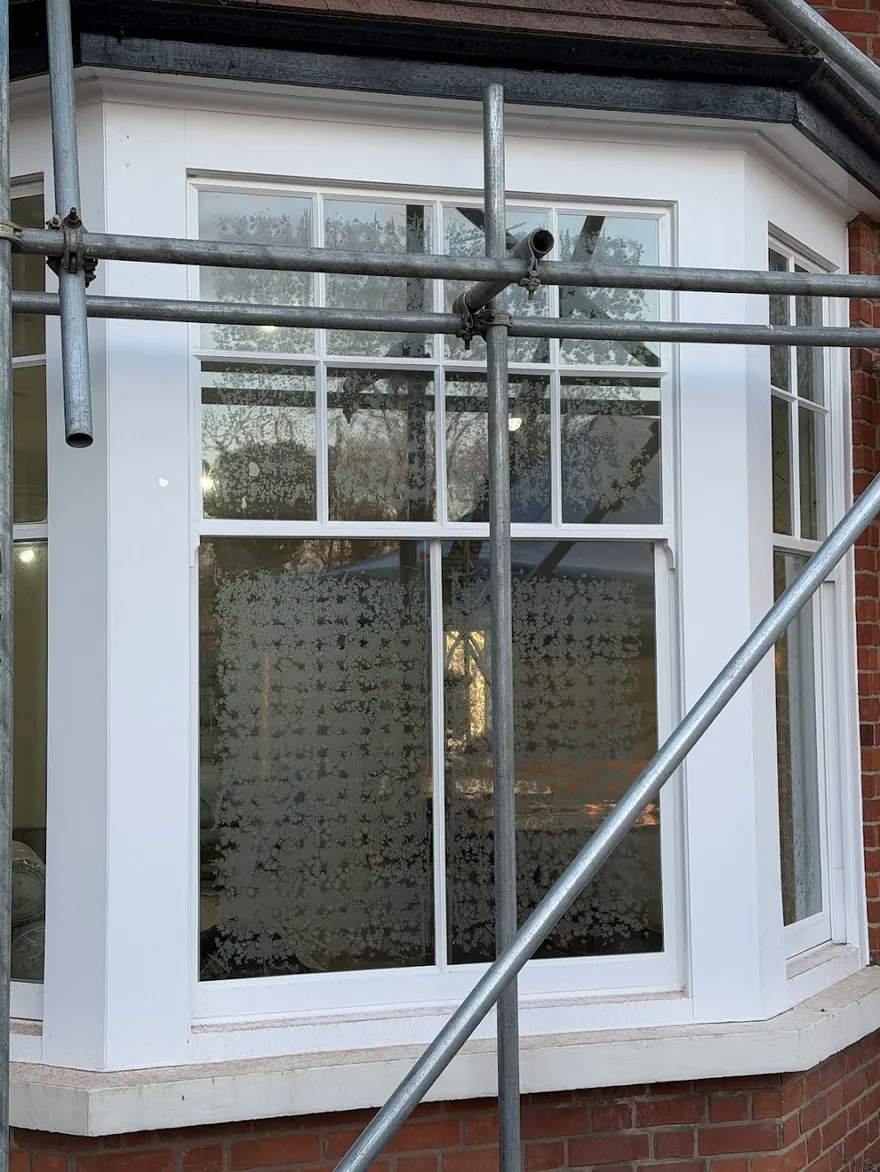
The pillars are, with the edge seal, the most consequential component in the whole assembly — we give them a full technical deep-dive in support pillars and edge seals.
5. The hermetic edge seal
Everything so far depends on one thing: the cavity staying sealed. Not sealed the way a double-glazed unit is sealed — where a slow leak means a misted cavity in twenty years — but hermetically sealed, at a leak-tightness closer to scientific vacuum equipment than to conventional building products. The seal runs around the entire perimeter of the unit, bonding the two panes together a few millimetres in from the edge, and it must stay airtight through decades of thermal cycling, wind load, rain, frost and the odd slammed sash.
Two sealing technologies exist, and the choice between them shapes the whole product:
- Glass-frit (solder glass) seals. A paste of low-melting-point glass powder is applied around the perimeter and fired in a furnace at roughly 350–450 °C, fusing the two panes into what is effectively a single piece of glass. The result is fully inorganic, rigid and very long-lived — glass sealed to glass, with no organic material to age or outgas. The costs: the firing temperature un-tempers toughened glass (which is why frit-sealed units use annealed panes), and a rigid seal is less forgiving of the expansion mismatch when one pane is hot and the other cold, making frit-sealed units somewhat more sensitive to thermal stress.
- Metal alloy seals. The alternative bonds the panes with a thin flexible band of metal — solder-like alloys applied at much lower temperatures, around 250 °C or below. Staying cool preserves the glass’s temper, so these units can use fully toughened safety glass; and a slightly flexible seal absorbs thermal movement and wind-load flexing far more gracefully than a rigid one. The engineering challenge is bonding metal to glass with vacuum-grade tightness and keeping it that way for decades.
Like the pillars, the seal is also a thermal compromise: a solid bond around the perimeter is a conduction path, which is why the edge of any vacuum unit runs slightly less warm than its centre, and why quoted centre-of-glass U-values flatter slightly compared with whole-window performance — a distinction we untangle in U-values explained.
6. The getter
The final component answers the question the previous five raise: even with a perfect seal, how does the vacuum survive for decades? Glass and seal materials are not perfectly inert. Over years, tiny quantities of gas outgas from the internal surfaces or permeate in through the seal at the molecular level. In a cavity this small there is no room for error: the volume between the panes is so tiny that even a minuscule amount of gas would raise the pressure enough to start conducting heat again.
The getter is the insurance policy. It is a small piece of chemically reactive material — typically an alloy of metals such as barium, zirconium or similar reactive elements — placed inside the cavity, often in a shallow recess in one pane. Its job is to capture gas molecules chemically, binding them permanently into its surface the moment they appear. Vacuum glazing generally uses non-evaporable getters: solid materials activated by heat during manufacture, which then sit passively for the life of the unit, mopping up strays. The same technology kept old cathode-ray tubes and vacuum flasks working; a window is simply its largest-area application.
The getter is sized for the expected gas load over the design life — decades of slow outgassing — and it works entirely unseen. If you ever spot a small metallic disc or strip near the edge of a unit, distinct from the pillar grid, you have found it. In some designs it is integrated into the edge seal region and invisible altogether.
Five components build the vacuum. The sixth exists to keep it — molecule by molecule, for decades, without moving parts or maintenance.
Where’s the pump-out port?
If you have read about vacuum glazing before — or looked closely at an early installation — you may be waiting for one more component: the small round button, tucked near a corner of the glass, that the first generations of vacuum glass carried. That was the pump-out port: a small hole in one pane fitted with a short tube, through which the air was extracted on the production line, then melted closed and covered with a protective cap.
It is increasingly a thing of the past. Modern production evacuates the whole assembly inside a vacuum chamber — the unit is sealed while already surrounded by vacuum, so no hole is ever needed and the finished glass is completely clean: no button, no cap, nothing to angle toward the least conspicuous corner. Some port-evacuated products remain on the market, so it is still worth asking when comparing quotes for a heritage project — but the industry’s direction of travel is clearly portless, and on a current unit you should not expect to see one. How the air actually comes out on a production line — the chamber, the furnaces, the bake-out — is a story of its own, told in how vacuum glazing is made.
How the six parts work together
Put the components back together and the unit reads as a single system, with the heat forced into a handful of small, known paths:
- Gas conduction and convection: eliminated by the evacuated gap, held permanent by the seal and the getter.
- Radiation: cut to a few per cent of its natural level by the low-E coating.
- Solid conduction: the residue — heat creeping through the pillar array and around the edge seal, the two deliberate compromises that make the unit buildable at all.
That residual solid conduction is why real units land at centre-of-glass U-values of roughly 1.1 down to ~0.4 W/m²K depending on design — pillar material and spacing, seal type, one coating or two — rather than at the near-zero figure an unobstructed vacuum would suggest. It is also why the technology keeps improving: sparser pillar arrays on tempered glass, lower-conductivity pillar materials and better coatings all chip away at the same three paths. For how those numbers compare with double and triple glazing — and what they mean on a real window — see our full guide.
It is worth being honest about failure modes, because they follow directly from the parts list. A vacuum unit does not mist up the way double glazing does; if the seal is ever breached, the vacuum is lost and the U-value degrades toward that of a simple double-glazed pane of the same dimensions — the glass stays clear, but the insulation quietly departs. Manufacturers quote service lives of 25 years and upward for the vacuum; those are manufacturer claims rather than independently proven track records at scale, and the honest position is that the oldest commercial units are approaching thirty years old and the technology’s real-world longevity is still being written.
The bottom line
A vacuum glazing unit is six components pursuing two jobs. The glass, the seal and the getter build and keep a near-perfect vacuum; the gap, the coating and the pillars decide how much heat still gets across. None of the parts is exotic on its own — float glass, a silver coating, steel discs, a fired seal, a strip of reactive metal — but each is specified at the edge of what its material can do, and the finished slab hides all of that behind the appearance of a single pane of glass. Understand the six parts and everything else about the technology follows: why it is slim, why it is expensive, why the pillars and seal set its limits, and why it can bring listed-building windows to modern thermal standards without changing how they look. For the standards and peer-reviewed research behind the figures in this guide, see our science and sources page.
Get the next issue
Vacuum glazing is moving fast — new products, prices and standards. Get the highlights and our independent take once a month, free.
- New products & price moves, the month they land
- Straight comparisons — Fineo, LandVac, Spacia & the newcomers
- Plain-English analysis from an independent team
You're on the list.
Check your inbox to confirm — then look out for the next issue. Thanks for reading.